
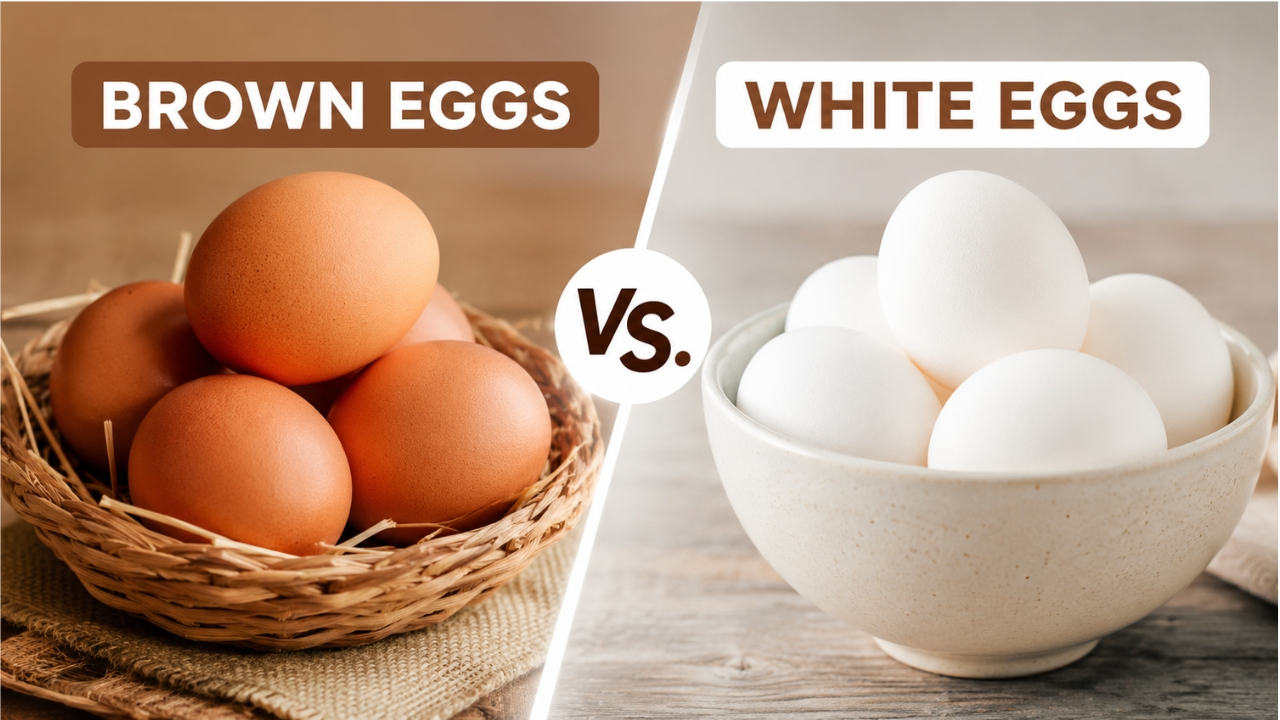
Stand in any egg aisle and you’ll see the same thing: a tray of brown eggs priced a little higher and a tray of white eggs beside it. Many shoppers assume the brown ones are more natural, more nutritious or somehow “cleaner.” The brown eggs vs. white eggs debate has been going for years, so here is what the shell does and doesn’t tell you.
Why Are Some Eggs Brown and Others White?
The color of an eggshell comes down to the breed of the hen. Breeds such as the Rhode Island Red typically lay brown eggs, while White Leghorns lay white ones. The pigment is deposited on the shell as the egg forms. In brown eggs it is mainly protoporphyrin, a compound related to the one that gives blood its red color. Some breeds lay blue or greenish eggs because of a different pigment, biliverdin.
Shade can vary even within one breed. Hen age, stress and diet can make shells lighter or darker, and older hens often lay larger, paler eggs. None of this changes what is inside the shell.
Brown Eggs vs. White Eggs: Nutrition Compared
When you compare brown and white eggs of the same size, the nutrition is essentially identical. Both are a compact source of high-quality protein, choline, vitamin B12, vitamin A, selenium and other nutrients, for roughly 70 calories per large egg.
| Feature (per large egg, approx.) | Brown Eggs | White Eggs |
|---|---|---|
| Calories | About 70 | About 70 |
| Protein | About 6 g | About 6 g |
| Fat | About 5 g | About 5 g |
| Choline | About 147 mg | About 147 mg |
| Shell pigment | Protoporphyrin | Little to none |
| Usually laid by | Larger breeds (e.g., Rhode Island Red) | Lighter breeds (e.g., White Leghorn) |
| Typical price | Often higher | Often lower |
| Taste | No color-based difference | No color-based difference |
Does Shell Color Affect Taste or Price?
Shell color does not affect flavor. Freshness, the hen’s feed, how the egg is stored and how you cook it matter far more. A fresh egg from a local farm can taste richer than a supermarket egg that has traveled and sat for weeks, whatever its color. Refrigerating eggs at a steady, cool temperature also helps keep their flavor.
The price gap has more to do with the hens than with quality. Brown-egg breeds are often larger and eat more feed, and many free-range and organic eggs happen to be brown, which pushes the average price up. You may be paying for the farming method rather than the color.
What Actually Makes One Egg Healthier Than Another?
If the shell doesn’t matter, what does? The hen’s living conditions and diet do. Hens raised outdoors with sun exposure tend to lay eggs with more vitamin D, and hens fed an omega-3-enriched diet produce eggs higher in omega-3 fats. Keep these points in mind when you shop:
- Free-range or pasture-raised: Hens have outdoor access, which can raise the vitamin D content of the eggs.
- Omega-3 enriched: These hens are fed a special diet, and the eggs carry more omega-3 fatty acids.
- Organic: The hens get organic feed and outdoor access, but this doesn’t automatically make the egg more nutritious.
- Cage-free: This describes the hen’s housing, and the egg’s nutrition is much the same as a conventional egg.
- Local or backyard: These eggs are often fresher, but check how they are handled and stored.
Whichever you choose, check the date on the carton, avoid cracked shells, and cook eggs until the whites and yolks are firm, especially for children, older adults and pregnant women.
SOURCE
Neither color wins. Brown and white eggs are equally healthy, so buy the one that fits your budget and look at the label for how the hens were raised. If you want a nutritional edge, choose free-range or omega-3 enriched eggs rather than the shell color you like best.
FAQs
1. Are brown eggs healthier than white eggs?
No. Brown and white eggs of the same size have virtually the same calories, protein, vitamins and minerals. The shell color reflects only the hen’s breed.
2. Which egg has more protein, brown or white?
Neither. A large egg of either color has about 6 grams of protein.
3. Why are brown eggs more expensive?
Brown-egg hens are often larger breeds that eat more feed, and many free-range and organic eggs are brown. The higher price reflects farming costs rather than extra nutrition.
4. Is it okay to eat eggs every day?
For most healthy people, one or two eggs a day can fit into a balanced diet. If you have a heart condition, high cholesterol or diabetes, check with your doctor or a registered dietitian about how many are right for you.
Pumpkin Seeds vs. Sunflower Seeds: Which Is Better for Protein, Fiber, and Magnesium
1 thought on “Brown Eggs vs. White Eggs: Which Is Better and Healthier? What Shell Color Really Tells You”